
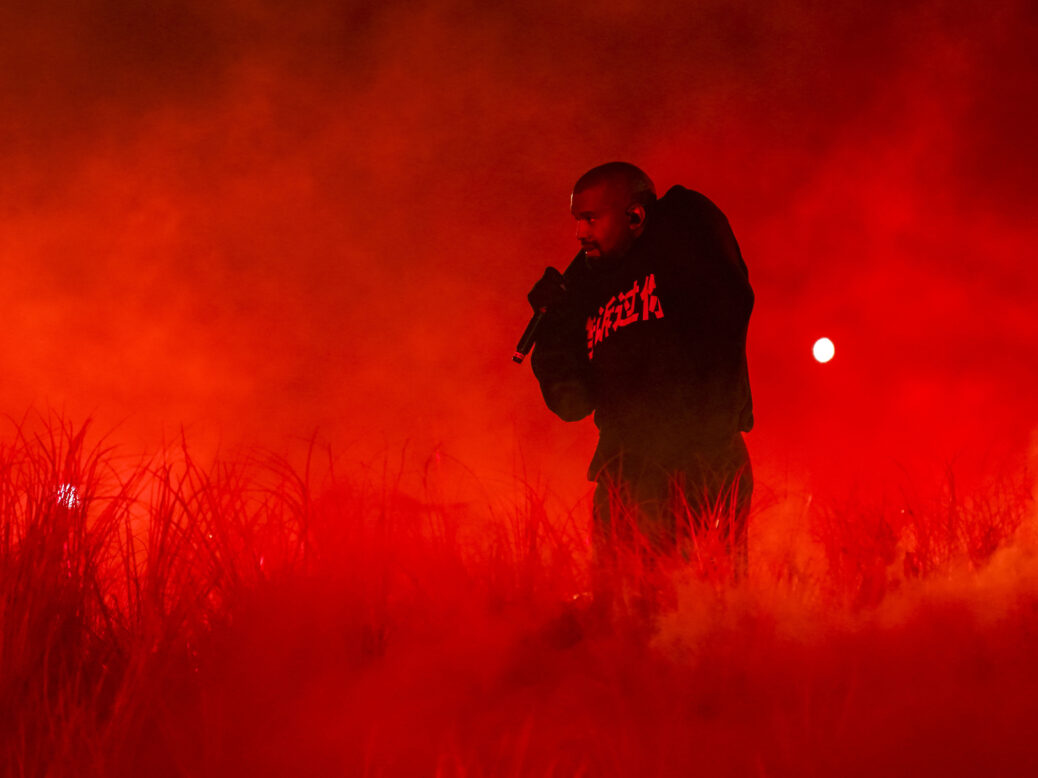
A government assailed by impossible choices made an easy one quickly and loudly. On 30 March, Kanye West, now known as Ye, was announced as the headliner for all three days of London’s Wireless Festival in July. Complaints from Jewish organisations and major politicians immediately followed, which were followed in turn by the withdrawal of Wireless’s sponsors, Pepsi, Diageo, Rockstar and PayPal. Yesterday, the Home Office announced it had revoked West’s permission to travel to Britain, and Wireless was cancelled.
It was an easy political choice, in so far as West’s recent history of extreme anti-Semitism – tweeting about being a Nazi and loving Hitler, and about “going death con 3 on Jewish people”; releasing a T-shirt emblazoned with a swastika and a song called “Heil Hitler” – will have no remotely mainstream defenders. But it seems unlikely that West would have repeated these sentiments on stage, given he took out a full-page advert in the Wall Street Journal in January apologising for them, and blaming them largely on his recurring struggles with severe mental illness.
Government edict will also not change how heavily his music is streamed and played on the radio here. Two songs from his album Bully, released less than a fortnight ago, are in Spotify’s top 50 British chart, with more than a million plays each in the last week. Bully debuted at number two on the US album chart; earlier this month, West earned $33m from two sold-out concerts in Los Angeles. He also has concerts booked this summer in Turkey, the Netherlands, Portugal, Spain and Italy, which have so far not been cancelled. This all emphasises the fact, established in large part by the Online Safety Act, that Britain is an international outlier in the aggressive policing of speech and media. That might well be a good thing, but we should at least acknowledge it.
Reasonable disagreements can be had on West’s travel ban, and on the extent to which his mental illness affects his responsibility for everything he has said and done. But the spectacle of his attempted comeback, after breaking some of the strongest taboos in the modern Western world, is familiar. His whole career has been an oscillation between glory and ignominy. After punching his way out of the “producer-for-hire” box and becoming a celebrated artist in his own right, he interrupted Taylor Swift’s victory speech at the 2009 MTV Video Music Awards. (“I’mma let you finish, but Beyoncé had one of the best videos of all time!”) Barack Obama called him a “jackass”. Then in 2010, he released My Beautiful Dark Twisted Fantasy, one of the best albums of the 21st century; he described it as a “long, backhanded apology”.

In 2016, he was admitted to psychiatric hospital, cancelled a tour, and began his on-off endorsement of Donald Trump; in 2018 he said slavery “sound[ed] like a choice”. Then in 2019 his album Jesus Is King topped the American charts. And then, in 2022, he fell in with far-right goons like Alex Jones and Nick Fuentes, and the long, long descent began.
What has made West so compelling is that the glory and ignominy were always intertwined. He’s a poet of self-pity, describing himself in one song as a “38-year-old eight-year-old”; in “Runway”, a highlight on Dark Fantasy, he demands we “have a toast for the douchebags”. And for a man who once rapped cod Nietzsche – “Nah-nah-nah, that, that don’t kill me/Can only make me stronger” – he has a deeply Christian commitment to the redemptive power of suffering.
This suffering often seems outrageously trivial to outsiders, especially compared with the suffering West himself has inflicted. But it has meant he’s been able to enact artistically the essential narcissism of the human condition like very few others. “Blood on the Leaves”, from his second masterpiece, 2013’s Yeezus, samples Nina Simone’s version of “Strange Fruit”, a heart-stopping song about a lynching in the Deep South. About as sacred as secular music can get. But West chops up Simone’s keening voice and uses it as a foundation for his postmortem of a messy break-up.
It is, in one sense, blasphemous, and incredibly true because of that. Many of us have, in low moments, felt the disintegration of a relationship as keenly as we might a death. Not many artists would be bold enough to acknowledge it. This mix of the sacred and the profane reappeared, in twisted, nightmarish form, in “Heil Hitler” last year. The song’s horn-backed hook is genuinely stirring. The problem is that the lyrics to the chorus go as follows: “All my n****s Nazis, n****, heil Hitler”.
Do not expect to hear it unless you go looking for samizdat social media uploads – West seems, at least while his mind and resolve hold, committed to rehabilitating himself. His UK travel ban is unlikely to affect that much, given the other markets that remain open at the moment to his performances and the continuing popularity of his non-fascist recorded music. Some people, obviously, will never forgive him. Others have been blithely bopping to “American Boy” for years with no interruption. But self-absorbed, performative penance has always been one of West’s greatest talents, and he still has ample room to demonstrate it.
[Further reading: The end of the American empire]
Content from our partners


Related

Join the debate
Subscribe here to comment